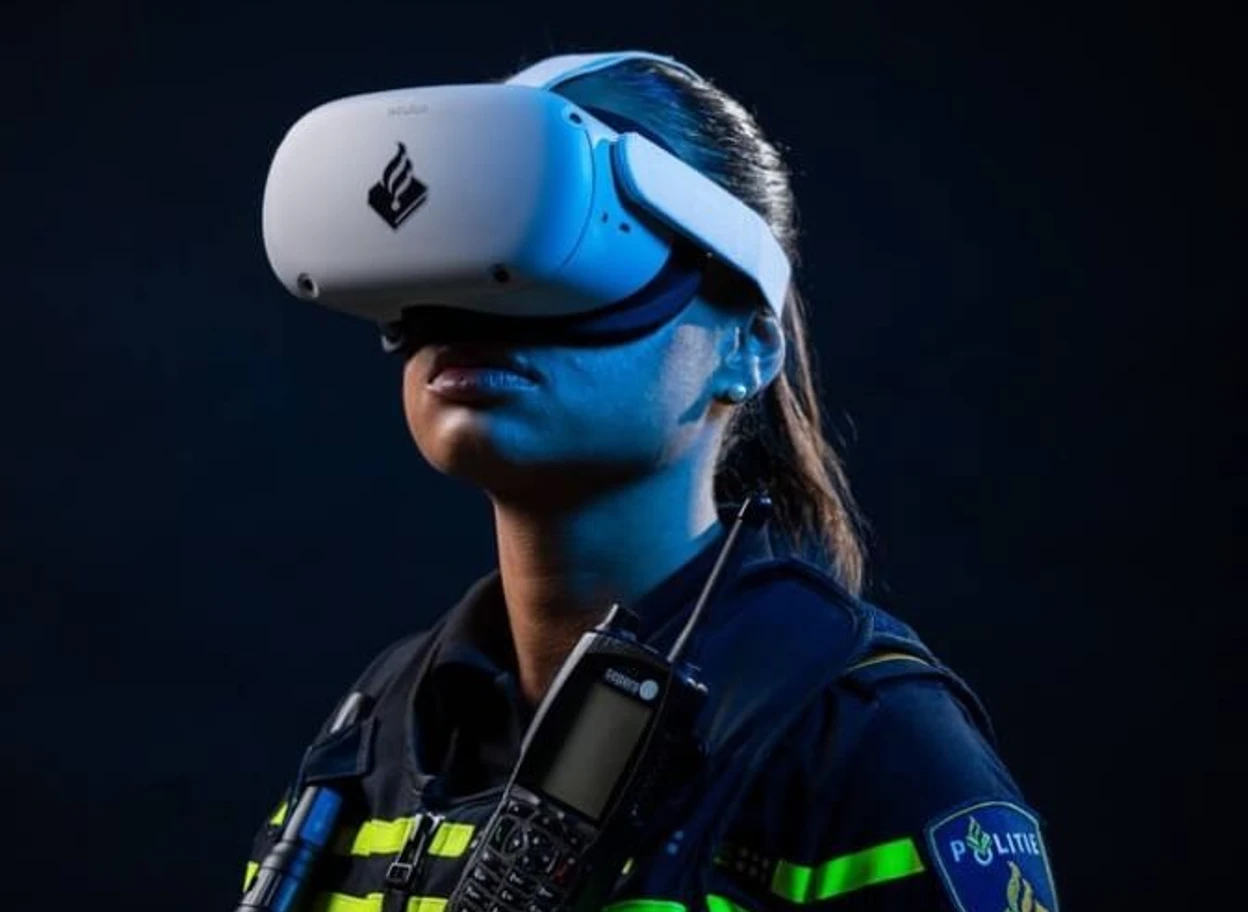
For several weeks now, the CIIIC scheme 'Innovation Impact Challenge: IX for the Dutch Police' has been open, which is seeking innovative solutions that contribute to more effective crime fighting and more efficient work processes. Directly involved Jelte Altena and Corine Laman from Team XR of the Dutch Police and Bobby Steijns on behalf of the RVO introduce themselves, provide an insight into the process, and their view on IX.
The Innovation Impact Challenge focuses on two themes:
- Agile and adaptive learning and preparation: can you use IX to help the Dutch Police prepare more quickly, actively, and flexibly for changing circumstances in society? (Think of the increasing number of riots.)
- Police action in new realities: can you think of IX solutions to support operational work in real-time? (Think of data that needs to be accessed rapidly.)
The Innovation Impact Challenge consists of a preliminary round (an Expression of Interest) and two phases (a feasibility study and a research & development phase). For more information, see our Call page or visit RVO's information page.
1. Who are you and what exactly do you do? And why 'immersive', in your opinion/senses, what is the importance of IX?
‘My name is Bobby Steijns, project advisor at RVO and specifically the lead from RVO for this Innovation Impact Challenge. In my work, I connect public organizations and entrepreneurs and do what I can to stimulate innovation. I've been interested in new technologies from a young age. My interest has always been sparked by new ways of developing or approaching things. A piece of lifelong learning that has lingered from my MSc [Master of Science] in Learning and Development in Organizations.’
‘We are Corine Laman and Jelte Altena from Team Extended Reality (XR) at the Dutch Police. Our team is responsible for the development and implementation of immersive technologies in the Police to make work safer, more efficient, and future-proof. Our society is changing rapidly, and forms of crime are changing with it. This requires us as Police to be agile and inventive in preparing and supporting our personnel. XR can help us train smarter and work more efficiently.’
2. Why 'IX for the Dutch Police' – what prompted it, what were your reasons for the call?
Jelte Altena: ‘Within the Police, we have been working with IX for years and mainly use it for the education and training of Police staff (particularly through VR) and the visualization of Crime Scenes. Both internally and externally, developing VR applications currently takes quite a lot of time, while we regularly face situations where we want to prepare our staff in a short period (sometimes within hours or weeks) for tasks they need to perform.
Consider quick preparations for unexpected threats: police officers must be able to prepare within a few hours for new, complex situations such as a hostage situation in an unfamiliar building or a sudden riot (without relying on physical training space or months-long development of an XR scenario/environment).
Or flexible training for new forms of crime: the Police must be able to quickly and effectively train for new societal phenomena such as designer drugs, where new behavior patterns emerge that we as Police want to respond to appropriately, or new forms of crime (such as digital extortion, deepfake fraud, or cyber threats) that are not yet included in existing training programs (without taking months or requiring costly resources).
Corine Laman: ‘We also deal with large amounts of data, data sources, and systems as Police, where colleagues on the street and during their duties at specific locations (such as homes) interact with data related to people or locations in various ways, such as requesting, receiving, recording, processing, registering, or linking it to other data. We see the opportunities for real-time deployment of IX in daily Police work growing: the technology and market are moving towards Augmented Reality and Mixed Reality, and we foresee that these technologies, combined with smart algorithms, could lead to significant efficiency gains in our way of interacting with data in the future.
This IX challenge is hopefully the key for us to solve these two persistent challenges: how do we prepare our Police colleagues in a shorter time for tasks they need to perform? And: how do we ensure that they have real-time access to crucial contextual data (such as personal data, safety risks, etc.) during their duties in the future and can also record it without unnecessary distractions, keeping their hands free for action?’
3. What exactly does the new call entail, and for whom in the community is it intended? What is the briefing for participants in a nutshell?
Bobby Steijns (RVO): ‘Most of it has already been said and explained, but we hope to reach creatives who have good ideas and, in combination with the latest IX developments, can develop adaptive (read: fast) and real-time solutions for the Police, which also 'hit the mark'. Technology and knowledge alone are often not enough; an experience must also be smartly designed to prompt behavioral change, in other words, to be effective.
The door is open for larger creators and smaller entrepreneurs who can also participate in the form of a partnership/coalition.’
Corine Laman: ‘This call challenges creative entrepreneurs to come up with innovative solutions that enable agile preparation and provide real-time visual support to our colleagues. Any entrepreneur wishing to work with IX in the security domain will have the opportunity with this call to work on concrete solutions in collaboration with potential clients.’
4. The call closes on Monday, October 13, at 12:00 PM. How many applications have been received so far? And how many players will eventually receive an assignment?
And what can interested parties do to learn more about the call and have a chance to win – initially – €25,000 (including VAT) for a feasibility study and later possibly up to €200,000 (including VAT) for a scalable project?
Bobby Steijns (RVO): ‘The call has been open since September 8, and the experience is that interested parties first need more information before submitting the idea they have via an Expression of Interest.
On September 22, there was a physical meeting, and on October 1, 2025, there was a digital follow-up meeting. The video can be watched here (with interactive and downloadable transcripts, ed.). However, there are also slides from the earlier information session and the market consultation report from earlier this year, which can be requested via innovationimpactchallenge@rvo.nl.
All about the call can be read via Call Innovation Impact Challenge: IX for the Dutch Police. Be sure to read it carefully.
What happens after October 13: an initial selection from the Expression of Interest is made by RVO, with a maximum of twenty parties per theme receiving an invitation on November 3 to submit a proposal for the feasibility study. An independent evaluation committee will assess the proposals, and a maximum of ten parties per theme will receive an assignment. The outcome of this will be on January 7, 2026.
To return to your first question: experience also shows that most applications come in at the last minute – people want to do as well as possible, although it remains risky – and more than enough applications are received. Especially with such an inspiring call as that of the Police.’
5. What is your IX dream/mission?
Bobby Steijns (RVO): ‘Our IX dream is that immersive technology – whether it’s virtual, augmented, or mixed reality – does not remain a gimmick, but is actually used to solve societal issues and improve people's daily lives. Through the innovation competitions, we are step by step building a chain of solutions where entrepreneurs, the government, and society experiment and learn together.
Our specific mission with CIIIC is to open new perspectives through immersive experiences: to better engage citizens in complex themes, to support professionals in their work, and to make services more accessible and inclusive for the market and society. Ultimately, we want IX services and products to not only be technological feats but to tangibly contribute to a more resilient and just society.’
Jelte Altena: ‘Our dream is that IX in the future will be as common within the Police as the current walkie-talkie or baton. We believe that this technology can be seamlessly integrated into every part of our work: from training where officers safely practice the most complex scenarios in VR, to event preparations with digital twin environments, and operational deployment where AR supports them in real-time with crucial information. Ultimately, it’s about one thing for us: that our colleagues can do their work safer, smarter, and more human-focused with technology that doesn’t distract but enhances their craftsmanship.’
6. To conclude, when is the call successful? What is the higher goal?
Bobby Steijns (RVO): ‘When not only innovation ideas are offered, which align well with the issues of the Dutch Police. But especially when these solutions eventually make it to the market and are adopted by the Dutch Police, and that the developed innovations can also be used for other clients so that there is a sustainable business case for the entrepreneurs.
Then the call has served its purpose to not only help the Dutch Police further but also the IX community as a whole.’
Corine Laman: ‘This call is indeed successful if we not only have innovative IX solutions that truly advance the Police and that we can integrate into our work in the short or (medium) long term, but also if we have been able to help entrepreneurs push their previous boundaries or broaden their scope.’