What if you could tell Netflix you want a cyberpunk adventure starring Jennifer Lawrence and Humphrey Bogart, then step into that world and actually live it—not as a passive viewer, but as someone whose choices reshape the story as it unfolds around you? This may not be science fiction anymore – even if today’s technology doesn’t quite allow for such levels of interactive immersion just yet.
According to Emmy-winning interactive narrative director Joshua Rubin, the convergence of AI, VR, and lessons from 150 years of immersive theater is bringing us closer to this reality than ever before. The question isn't whether it will happen, but whether we'll build these worlds as meaningful playgrounds for human connection or descend into what he calls "AI dystopian slop."
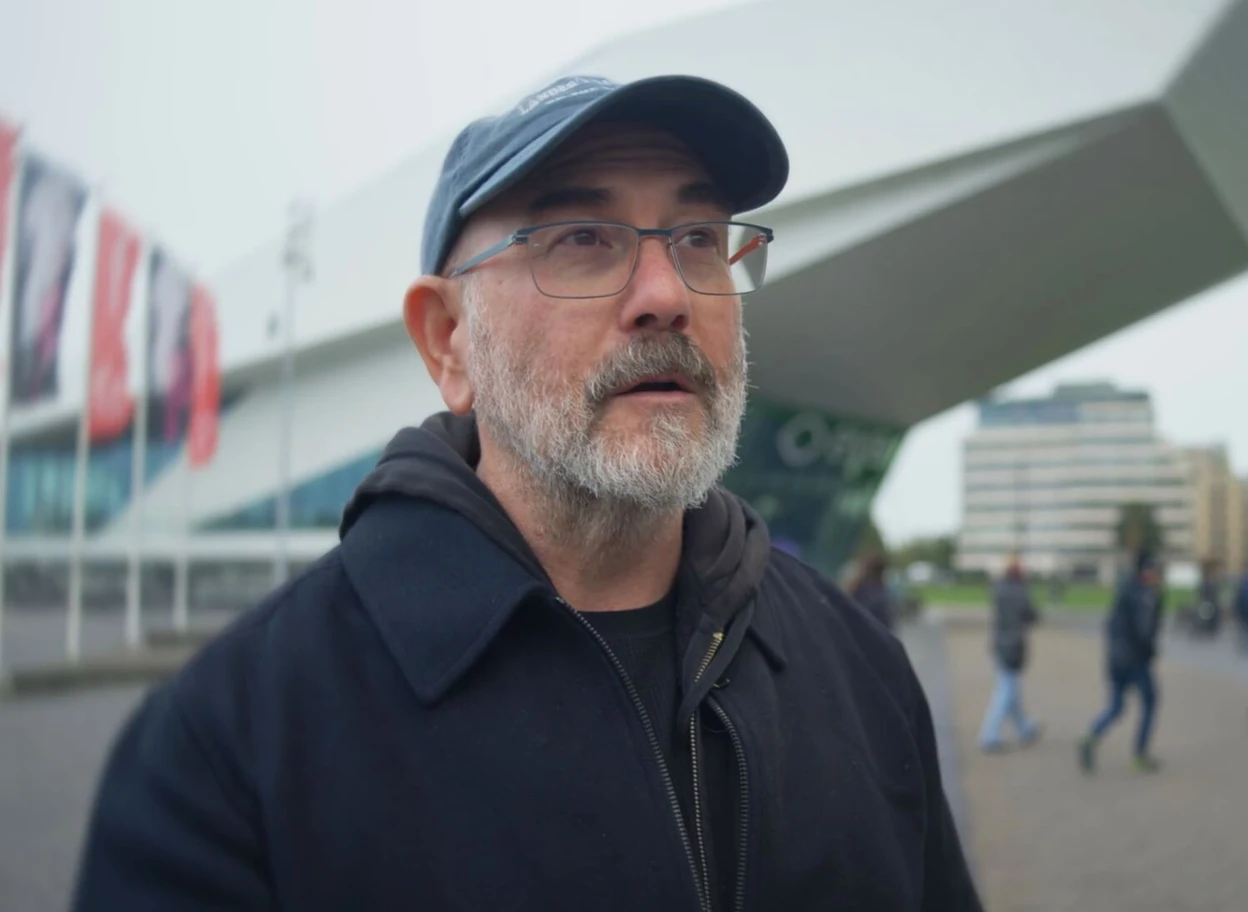
On the morning of Friday, October 3rd, CIIIC and the Dutch Games Association hosted an exclusive masterclass with Rubin at EYE Filmmuseum in Amsterdam. Drawing from his 25-30 years creating interactive experiences—from Assassin's Creed 2 and Destiny to The Walking Dead and his current work as narrative lead on Orion Drift—Rubin explored the central tension facing interactive storytelling: how to give players radical freedom while still delivering the structure and catharsis that make stories meaningful. Through examples spanning video games, immersive theater, VR experiences, and emerging AI characters, he laid out a framework for "story living"—experiences defined by radical agency, hyper-reactivity, and deep personalization.
Using examples from video games, immersive theater, VR, and emerging AI characters, Rubin introduced his framework for "story living" - experiences defined by radical freedom of choice, hyperreactivity, and deep personalization.
Past: from theater to video game
According to Rubin, interactive stories fulfill an ancient human need. A century and a half ago, theater already offered a form of immersion: experiencing, feeling, and reflecting together. Video games added agency to that; the ability to make choices that affect the course of the story.
Yet, one question remains central: how do you combine the player's freedom with the emotional structure of a well-told story? Rubin calls this the central tension of interactive storytelling: freedom of choice versus catharsis.
The key, according to him, lies in “story living”; stories in which you not only observe but become part of the story yourself. While theater and games each offered their own form of immersion, we now find ourselves at a new crossroads. The technology is mature enough to build worlds that combine both — but the question is: are we as humans ready for it?
Present: between technology and human
The current state of IX is promising, as we see at CIIIC, but also full of obstacles. The technology is there — but the language is not yet. Creators, designers and artists are looking for new forms to create meaningful experiences that go beyond spectacle or technical virtuosity.
The biggest challenges are not technological, but human. How do you make choices tangible and not just interactive? How do you let players experience freedom without the story losing its direction? And how do you scale such intimate experiences without them losing their soul?
It is becoming increasingly clear that true immersion is not about glasses, headsets or algorithms, but about what they enable: moments of wonder, connection and play. The future of IX does not lie in even more technology, but in finding the right balance between man and machine.
Future: from AI to human connection
Rubin does not see artificial intelligence as a threat, but rather as an opportunity to make stories more human. In his vision, the future of immersive storytelling lies in AI characters that can improvise — not to replace humans, but to guide players in making meaningful choices. The more AI takes over tasks, he says, the more we will appreciate the human experience itself.
In that context, theatre becomes valuable again: intimate, physical and personal. Where film became mass-market, theatre — and by extension IX — offers the closeness that people long for. Playfulness plays a central role in this. Rubin calls it ‘as essential as sleep’ because it gives us the freedom to explore, connect and find meaning again.
Rubin saw a striking example of how technology and humanity can merge at SXSW 2025, where we met Rubin, in the Dutch immersive experience Ancestors by Steye Hallema's Smartphone Orchestra, which later won a Golden Calf for Best Digital Culture Production. The experience, in which 24 strangers formed a single collective symphony with their smartphones, touched him deeply. According to Rubin, Ancestors showed how technology can serve as a catalyst for human connection: not just by telling stories, but by experiencing them together.
The Vision: Beyond Passive Entertainment
Rubin opened with his fantasy of telling Netflix he wants a cyberpunk adventure starring Jennifer Lawrence and Humphrey Bogart, then entering that world through VR goggles—not just watching, but making meaningful choices that dynamically reshape the story. This isn't the dystopian "AI slop" of Brave New World's feelies, but rather the holodeck fantasy Janet Murray described in Hamlet on the Holodeck: well-told, interactive stories personalized for each participant.
He cited Chris Milk's observation that VR represents "the ability to experience a story with another person that you live together rather than watch together inside of what is essentially an author dream." This concept of fundamentally changing how we connect to stories and each other has served as his north star.
Defining Story Living
Rubin distinguishes "story living" through three core principles:
- Radical agency: Not just preset choices, but freedom to do what you want
- Hyper-reactivity: The world "yes-ands" anything you do
- Deep personalization: The story knows you well enough to deliver what you need
The Scalability Challenge
Live theater in VR offers unlimited interactivity through human actors performing in real-time, but doesn't scale beyond small groups. Companies like Metamovie's Alien Rescue put players on space pirate crews where companions are trained actors—wonderful and intimate, but limited.
The obvious answer is AI, rapidly evolving from simple chatbots to fully agentic personalities. Fortnite recently deployed an AI Darth Vader that players could converse with during combat. Despite occasional glitches, what mattered was how quickly a responsive character rewired the gaming experience, moving from scripted cutscenes to improvising partners.
Ronnie Abovitz, founder of Magic Leap, proposed the "Kyoto test"—where you can wander down any alley, talk to any old woman in a tea shop, hear her complete history, and pursue threads from her past. But Rubin argues a simulacrum of life isn't enough—he wants stories, not just simulated existence.
The Central Tension: Agency vs. Catharsis
Agency—the freedom to do what we want—is what players crave. Catharsis—structure, purpose, and theme—is what audiences crave when reading or watching films. Can we have both, or are they fundamentally at odds?
Rubin's answer: they are completely at odds, making it extremely difficult to achieve both. However, 150 years of immersive theater and 50 years of video games have developed tools and techniques to bridge this gap.
Maxim 1: Activity Is Not Agency
Drawing from examples like Punchdrunk's Sleep No More, Rubin emphasized that despite feeling radically free, many immersive experiences offer only a narrow band of interactivity—your agency is merely where to stand and what to look at. True radical agency means the world reacts, adapts, and evolves based on your actions.
Agency isn't something you see; it's something you do.
Maxim 2: You Are Not the Audience, You Are the Story
Being the protagonist requires the world to hold up its end of the bargain and feel real. Rubin explored extreme examples like You Me Bum Bum Train, where one participant at a time moves through 75 minutes of rooms, each casting them as the main character—coaching a football team, negotiating a hostage crisis, or even being a piece of sushi on a tray.
Maxim 3: The Deeper You Believe, the More Freely You Play
Belief is fragile. Johann Huizinga's concept of the "magic circle"—an invisible boundary separating the real world from the world of play—is essential for immersive experiences. Once you step inside and accept those rules, you feel safe enough to let go.
Video games achieve this through diegetic design—mechanics existing inside the world rather than as external UI. Rubin advocates expanding this to "diegetic story," where narrative elements live naturally within the world itself, as seen in Meow Wolf's House of Eternal Return.
But belief alone isn't enough. People need a social framework—an "alibi to play"—that gives permission to participate. Just as nightclub lights and music give us an alibi to dance, when everyone around you is role-playing full tilt, so can you.
Maxim 4: Story Worlds Unfold Through Discovery
Players want to discover stories themselves rather than follow them. But without direction, a story world becomes just a world. This is where "story magnets" come in—elements that naturally draw participants toward key story points through curiosity rather than overt direction.
Amusement parks use "weenies"—massive landmarks like Cinderella's castle visible from anywhere. Recent Legend of Zelda games use this masterfully, filling horizons with landmarks that ignite curiosity and pull you over the next hill.
Sam Barlow's Her Story demonstrates "spoken weenies"—mystery hooks embedded in narrative. Players search a database of interview clips by typing keywords, but Barlow strategically embedded intriguing proper nouns that naturally lead from one discovery to the next. You feel entirely in control, but the designer always knows which door you'll take because it's the most interesting one given to you.
Good interactive storytelling doesn't force players down paths—it lays out breadcrumbs they want to follow.
Meaningful Choice and AI Character Design
As we move into AI-driven interactions, best practices still apply: open-ended conversations are boring. The best scenes give players a goal and multiple options to achieve it through different strategies. Crucially, narrative designers should "yes and" the player, never punishing choices.
AI character designers have started conceptualizing using Stanislavski's improv framework with two simultaneous LLMs running a single character. One acts as the "intention engine," ensuring the character stays true to personality, while the other functions as the "event engine," moving the scene toward the next required moment.
Director Jack Aldeser of The Mannequins calls these moments "cadenzas"—structured improvisation where the performer is free to explore but the composition never loses its shape. It's "improv that feels like it was supposed to happen."
Final Maxim: Freedom in Play, Structure in Design
Whether using AI, live actors, or live actors in VR, the best interactive characters let players drive the experience while carefully ensuring the story still lands. When structure holds, players relax, stop testing the seams, trust the story, and give themselves over to play.
Conclusion
The future of IX is not about technology, but about rediscovering humanity. If AI and immersive media allow us to not only see stories, but to experience them — to better understand ourselves and others — then they can play a key role in how we create meaning together.
As Esmeralda Massaut puts it: ‘If we can help people experience a better quality of life, that's the ultimate dream.’ Or, as Rubin says: ‘The future of storytelling isn't on a screen — it's in the space between us.’
At its core, story living is about rediscovering the parts of ourselves that are still capable of wonder — and about building worlds worth believing in. Technology is merely the medium. What matters are the stories we choose to experience together.
In conversation with the visitors
After Rubin's presentation, participants engaged in discussions about the opportunities and challenges of immersive experiences. We spoke at length off camera with Ard Bonewald (Breda University of Applied Sciences) and Esmeralda Massaut (Enliven) about what they took away from the talk and how they view the future of the field.
Ard Bonewald sees AI as a valuable opportunity to enrich IX, but also warns of the ethical tensions that come with it. “How do we ensure a good balance between agency and suspension of disbelief?” he wonders. “What happens when transparency and ethics clash with creative freedom?” According to Bonewald, designers should not become fixated on technology but remain aware of the moral implications of their choices.
Also, Esmeralda Massaut emphasized how powerful IX can be in making societal themes palpable. “The greatest opportunity of IX is to make elusive themes tangible,” she says.
At the same time, she points out the limitations of current technology, such as the limited computing power of standalone VR headsets and the accessibility for a broader audience. According to her, the challenge lies in maintaining humanity in the experience: “It's not about the technology, but about what it sets in motion for the user.”
On camera — as seen in the video below this article — we also spoke with Puck van Dijk (Studio Puck van Dijk) and Eva Marsálková (Explore Deep) about where they see the greatest opportunities. Puck van Dijk emphasizes that every strong IX experience starts with a good story. According to her, AI is not yet flawless, but that's where the potential lies: “We feel in every way that this is just the beginning.” She also advocates for more attention to the physical, sensory side of experience: “We are not robots — it must remain human and tangible.”
Eva Marsálková adds that she learned from Rubin that there are different levels of immersion — from full immersion to passive participation — and that designers need to learn to design for all these layers simultaneously. Additionally, she mentions the high cost of hardware as a significant barrier, as well as the question of how much agency users will truly retain in the future.
Despite the obstacles, optimism was the prevailing sentiment among the visitors. IX is growing, experimenting, and demonstrating that technology and humanity do not have to be at odds but can actually enhance each other in the future.
---
CIIIC would like to thank Joshua Rubin for sharing his insights and the Dutch Games Association for co-organizing this inspiring masterclass. You can follow Joshua Rubin on Linkedin, BlueSky and Instagram; read more on is website subverse-interactive.com. Make sure to support his Kickstarter project for a Sci-Fi Comic titled TIME SENSITIVE #1, a project by Strangeland Comics.